
Dental implants in Cieszyn – learn about the stages of treatment
The loss of even a single tooth can affect eating comfort, the appearance of your smile, and the alignment of remaining teeth. At Park Medical in Cieszyn, we help patients restore missing teeth using modern diagnostics and individually planned treatment.
Are you wondering what dental implant placement involves, whether the procedure hurts, and how long the entire process takes? In this article, we explain all the stages of implantation – from the first consultation to the placement of the final crown.
What actually is a dental implant?
Simply put, an implant is a small component that replaces the root of a missing tooth. It is most often made of titanium – a material well tolerated by the body.
The implant is placed in the jawbone, where over time it integrates with the surrounding bone tissue. This creates a stable foundation for the future prosthetic restoration.
It is worth knowing that the implant itself is not a complete tooth yet. The final restoration consists of three elements:
- Implant – replaces the natural tooth root and is placed in the bone.
- Prosthetic abutment – connects the implant to the visible part of the restoration.
- Prosthetic crown – restores the appearance and function of a natural tooth.
A properly crafted crown is matched to the color, shape, and size of the adjacent teeth. As a result, the restoration can look very natural, and the patient regains the ability to eat comfortably and smile freely.
Why is it worth replacing a missing tooth?
Some patients postpone replacing a tooth, especially if the gap is in the back of the mouth and not visible when smiling. However, it is worth remembering that tooth loss can have consequences extending beyond aesthetics.
Over time, adjacent teeth may start shifting toward the gap, and the opposing tooth may gradually extrude from its socket. The lack of proper load on the bone where the tooth was lost also promotes bone loss.
Implants allow you to not only restore a missing tooth, but also reduce some of these unfavorable changes.
The main advantages of dental implants include:
- Natural appearance – an implant crown can be virtually indistinguishable from your other teeth.
- Stability – the restoration is permanently fixed and does not shift while eating or speaking.
- Protection of adjacent teeth – with a single implant, healthy teeth usually do not need to be ground down, unlike with a traditional bridge.
- Comfort – once treatment is complete, you can bite and chew most foods freely again.
- Reduced bone loss – the implant transfers loads to the bone, helping to preserve its structure.
- Long-term durability – with proper hygiene and regular check-ups, an implant can last for many years.
Importantly, implants are not a solution reserved exclusively for people who have recently lost a tooth. Patients with long-standing missing teeth can also benefit from implant treatment.
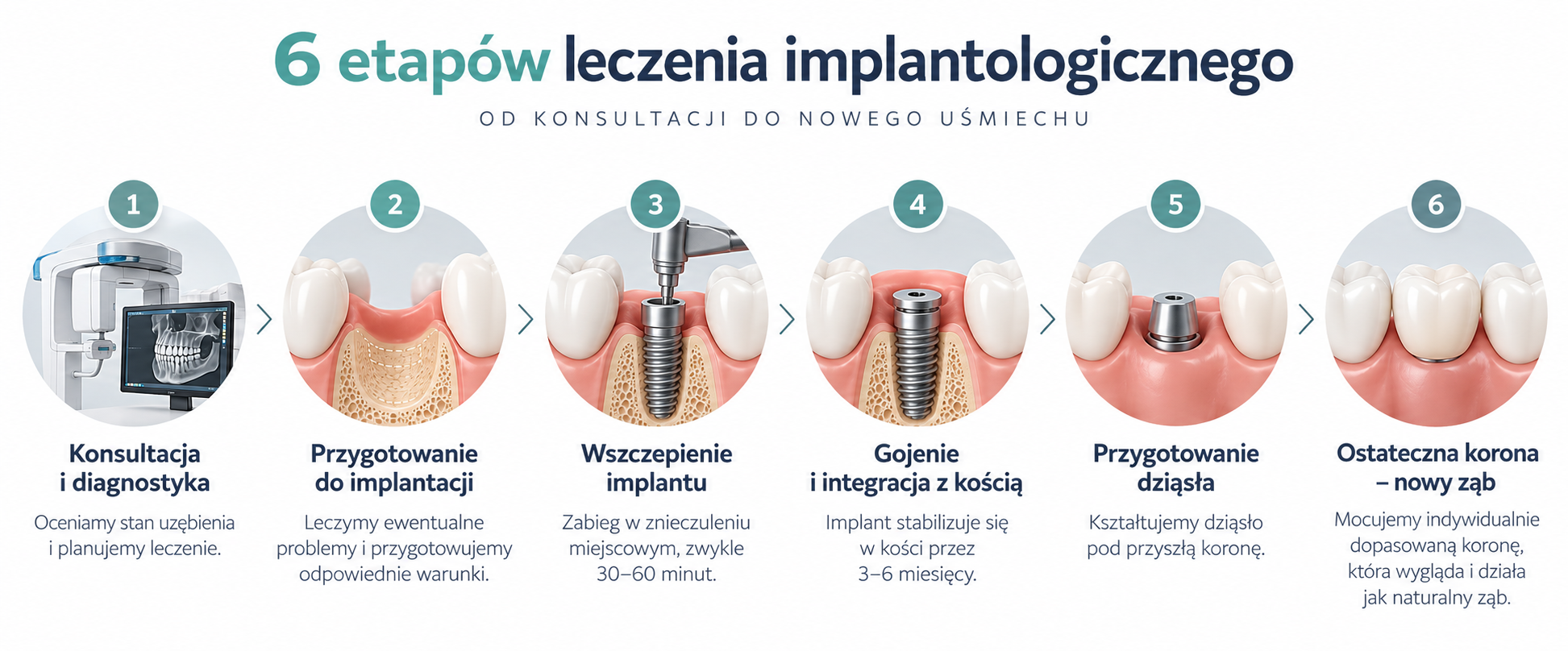
What does dental implant placement look like? Discover the 6 stages of treatment
Contrary to common belief, implantation does not involve a single long and complex procedure.
It is a planned process consisting of several stages. Most of the time involves natural healing and osseointegration with the bone, whereas the surgical procedure itself is usually relatively short.
Stage 1. Consultation – finding the best solution for you
The first visit does not mean having a procedure right away. Above all, it is a time for conversation, understanding your expectations, and evaluating treatment options.
The doctor takes a medical history, checks the condition of your teeth and gums, and assesses the site where the implant would be placed. Diagnostic imaging is one of the most important parts of preparing for implantation.
Why is computed tomography so important?
For the implant to be placed correctly, the doctor must thoroughly evaluate the anatomical conditions at the planned procedure site. At Park Medical, we have a modern Carestream CT scanner that enables 3D CBCT imaging.
Among other things, the scan allows us to evaluate the volume and shape of the bone, the position of adjacent tooth roots, and the course of vital anatomical structures. This allows the doctor to precisely plan the implant position and assess whether additional preparatory procedures will be necessary.
For the patient, this primarily means greater treatment predictability and the opportunity to thoroughly discuss the planned procedure before it even begins.
Stage 2. Preparation for implantation
Not every patient can proceed with implantation immediately after the consultation. Sometimes, it is necessary to first treat tooth decay, gum inflammation, or other oral health issues.
The condition of the tissues surrounding the future implant is particularly important.
What if there is not enough bone?
After a tooth is extracted, the bone gradually resorbs. The more time that has passed since its loss, the higher the likelihood that additional procedures will be required.
However, this does not mean that implantation is impossible. In many cases, a bone reconstruction procedure, known as bone augmentation, can be performed.
It involves creating suitable conditions for the stable placement of the implant. In the posterior regions of the upper jaw, a sinus lift procedure may also sometimes be necessary.
Whether such procedures are needed is determined on an individual basis by the doctor based on diagnostic results.
It is worth emphasizing that even a missing tooth of many years does not necessarily rule out the possibility of restoring it with an implant.
Stage 3. Implant placement – the procedure itself is shorter than you think
This is the moment that causes the most anxiety for many patients. In reality, placing a single implant is usually much less time-consuming than you might expect.
The procedure is performed under local anesthesia, similar to that used during tooth fillings or extractions. Once the doctor ensures the anesthesia is working properly, they prepare a site in the bone for the implant.
Next, a titanium implant is placed into the bone, which will function as the new tooth root. Depending on the technique used, the surgical site may be secured with sutures or a healing cap.
How long does it take to place a single implant?
Placing a single implant is usually a relatively short procedure. The surgical procedure itself can take about 30–60 minutes, but it is advisable to allow about 1–2 hours for the entire visit.
The exact duration depends on individual anatomical conditions and the scope of planned treatment.
Is there any pain during the procedure?
Thanks to local anesthesia, patients should not feel pain during implant placement. However, a feeling of pressure or slight vibration may be experienced.
Temporary symptoms such as tenderness, mild swelling, or discomfort around the implantation site may occur after the procedure. These are usually most noticeable during the first few days and gradually subside.
After the appointment, the doctor provides detailed guidelines regarding oral hygiene, diet, and care during the healing period.
Stage 4. Healing – the implant integrates with the bone
After the implant is placed, a process called osseointegration begins. While the name may sound complicated, it simply refers to the natural bonding of the implant surface with the surrounding bone.
This process is precisely what makes the implant a stable foundation for the future crown. Healing usually takes anywhere from a few weeks to several months.
In many cases, waiting for the final restoration takes about 3-6 months. The exact time depends, among other factors, on bone quality, implant location, and the patient's individual health conditions.
Do you have to go without a tooth for this entire time?
Not necessarily. In many cases, a temporary restoration can be used, allowing you to maintain the aesthetics of your smile during the healing period.
This is particularly important when the implant replaces a front tooth. In some patients, it is even possible to attach a temporary crown immediately after placing the implant.
However, it cannot always be normally loaded when eating right away. The choice of the right solution depends on bone conditions, implant stability, and the individual treatment plan.
Stage 5. Preparing the gum for the new tooth
Once the implant successfully integrates with the bone, preparations for crafting the final crown can begin. If the implant was covered by gum tissue, the doctor performs a minor procedure to uncover it.
Next, a special component called a healing cap is fitted. Its purpose is to properly shape the gum tissue around the future restoration.
This stage is particularly essential for front teeth, where not only the appearance of the crown matters, but also the natural contour of the gum line. Not every patient requires a separate implant uncovering procedure.
Sometimes, the healing cap is attached during the initial procedure.
Stage 6. The final crown – your new tooth is ready
This is the stage patients look forward to most. Once healing is complete and the tissues are prepared, the final prosthetic restoration can be crafted.
The doctor takes an impression or performs a digital scan of the teeth, based on which a custom crown is created.
Modern digital scanning at Park Medical
At our clinic, we use a 3Shape intraoral scanner, which allows for precise digital mapping of the dentition. In appropriately selected cases, scanning can replace traditional impressions, offering greater comfort for many patients.
Based on the acquired data, a crown matched to the remaining teeth is prepared. We take into account not only its color, but also its shape, size, positioning, and how it contacts the opposing teeth.
The finished restoration is secured to the implant.
From that moment, the patient can enjoy a restored tooth that looks natural and restores comfort in daily functioning.
Are dental implants durable?
One of the most common reasons patients choose implants is their long-lasting durability. A properly placed implant, with appropriate care, can last for many years or even decades.
However, it is important to remember that an implant – just like natural teeth – requires regular hygiene and check-ups. Although the implant itself cannot develop tooth decay, the tissues surrounding it are vulnerable to inflammation.
Therefore, after completing treatment, daily brushing, interdental cleaning, and regular check-up and dental hygiene visits are particularly important. The longevity of implants is also affected by overall health, smoking, periodontal disease, and how the prosthetic restoration is loaded.
Dental implant or dental bridge – which to choose?
Patients with a single missing tooth often wonder whether an implant or a traditional bridge is the better solution. Both methods make it possible to restore a missing tooth, but they differ in their approach.
In the case of a dental bridge, it is usually necessary to prepare (grind down) the teeth adjacent to the gap. They serve as abutments supporting the restoration.
An implant, on the other hand, allows a missing tooth to be replaced independently of adjacent teeth. In many cases, this helps preserve their natural structure.
An implant also helps reduce bone loss at the site of the missing tooth. However, this does not mean that an implant will always be the best solution.
In some situations, a bridge or another prosthetic restoration may be more suitable. That is why it is best to make a decision together with your doctor after a thorough evaluation of the conditions in your oral cavity.
How much does a dental implant cost?
The cost of implant treatment depends on the patient's individual needs and the scope of necessary procedures. It is worth keeping in mind that the cost of placing an implant does not always represent the price of a complete tooth.
The total cost of treatment may include consultation, diagnostics, implant placement, prosthetic components, and the final crown. If prior bone reconstruction or additional procedures are required, the overall treatment cost may be higher.
Therefore, before making a decision, it is advisable to request a treatment plan that outlines all anticipated stages.
The current price list is available here.
During a consultation at Park Medical, the doctor will evaluate the options for replacing the missing tooth and present a proposed treatment approach along with its estimated costs.
Frequently asked questions about dental implants (FAQ)
Does dental implant placement hurt?
The procedure is performed under local anesthesia, so it should not cause pain. Once the anesthesia wears off, minor discomfort, tenderness, or swelling may occur, which usually subsides gradually over a few days.
How long does implant placement take?
Placing a single implant usually takes about 30–60 minutes. The entire treatment process, including healing and crown placement, can take several months.
Can an implant be placed on the day of tooth extraction?
Yes, in many cases, an implant can be placed during the same visit as the tooth extraction. This procedure is known as immediate implant placement.
It allows total treatment time to be reduced and avoids the need for two separate surgical procedures.
However, not every case qualifies for immediate implant placement. The decision depends on factors such as bone condition, the presence of inflammation, and the ability to achieve adequate implant stability.
Learn more: Dental implant right after tooth extraction
Can you get a new tooth in one day?
In some cases, a temporary crown can be placed immediately after implant placement. However, the final restoration requires proper preparation and time for the healing process.
Does an implant look like a natural tooth?
Yes. Modern prosthetic materials make it possible to create crowns that closely resemble natural teeth.
A properly selected restoration blends seamlessly with the remaining teeth.
How long does a dental implant last?
Implants can last for many years or even decades. Their longevity depends on factors such as proper oral hygiene, overall health, and regular check-ups.
However, it cannot be guaranteed that an implant will last a lifetime.
Can the body reject an implant?
Titanium is a material very well tolerated by the body. However, there are cases where the implant does not integrate properly with the bone or complications occur, such as inflammation of the tissues surrounding the implant.
Can implants be placed at any age?
There is no upper age limit for implant treatment. Overall health and oral conditions are far more important.
In young patients, implant placement is usually performed after jaw bone growth is complete.
Can an implant be placed if a tooth has been missing for 10 or 20 years?
Yes. A tooth missing for many years does not rule out implant placement.
However, it may be associated with bone loss, which sometimes requires preparatory procedures beforehand.
Is diabetes a contraindication for dental implants?
Not always. Patients with well-controlled diabetes may qualify for implant treatment.
However, uncontrolled diabetes increases the risk of impaired healing and complications.
Does smoking affect dental implants?
Yes. Smoking increases the risk of healing complications, inflammation, and implant failure.
Therefore, quitting smoking is recommended, especially in the period around the procedure.
Can you eat normally after getting an implant?
Immediately after the procedure, you should follow your doctor's dietary recommendations and avoid putting excessive pressure on the implant site. Once treatment is complete, the implant with the crown usually allows you to comfortably enjoy most foods.
Can you return to work after the procedure?
After an uncomplicated implant placement, many people return to desk jobs as early as the next day. For more extensive procedures or physical labor, your doctor may recommend a longer rest period.
Do dental implants require special care?
Implants require regular hygiene, just like natural teeth. Thorough brushing, cleaning interdental spaces, and regular dental check-ups are essential.
Can multiple implants be placed during a single visit?
Yes. Depending on the anatomical conditions and treatment plan, it is possible to place several implants during a single procedure.
What should I do if I am afraid of dental implant surgery?
It is a good idea to share your concerns during your first consultation. The doctor will explain the procedure, discuss anesthesia options, and answer your questions.
Simply understanding the subsequent stages of treatment often helps reduce anxiety.
Dental implants Cieszyn – why choose Park Medical?
W Park Medical in Cieszyn we focus on precise diagnostics, personalized treatment planning, and patient comfort.
Thanks to state-of-the-art diagnostic facilities, including a Carestream CT scanner and a 3Shape intraoral scanner, we can thoroughly evaluate anatomical conditions and plan the next stages of dental restoration.
We understand that deciding on dental implants can come with concerns. That is why the initial consultation is primarily an opportunity to talk, learn about available options, and get answers to all your questions.
You do not have to decide on the procedure right away. All it takes is taking the first step.
If you are missing one or several teeth, book an implant consultation at Park Medical. We will check which treatment options will be suitable in your case.
Take care of the health, comfort, and natural appearance of your smile.